Why Allergy Prone Homeowners Need To Consider Duct Cleaning
You vacuumed the living room on Saturday. Sunday afternoon the coffee table’s dusty again and your face feels packed with cotton. If you’re allergy prone, you know the cycle. But before you order another purifier off the internet, take a screwdriver to a supply register and put your phone light down the boot. Whatever you find sitting there tells you most of what you need to know.
What Collects In Prescott Ductwork
We’re at 5,300 feet in juniper country. Late January through March, that pollen gets into everything, and everything includes return ducts with seams somebody taped once back in the nineties.
Then July hits and the monsoon winds push decomposed granite dust in behind it.
I pulled a return grille off a place up Williamson Valley Road last March. Quarter inch of tan powder sitting in the low spot of the flex, like the bottom of a vacuum canister. Two horses, dirt drive, windows finally open because it was nice out for the first time in months. The lady apologized to me. She hadn’t done anything wrong.
For an allergy prone house that buildup is worth knowing about. Though I’ll say houses in town with sealed metal trunk lines running through conditioned space, I open those up after fifteen years and there’s hardly a thing in them.
Cleaning Gets What’s In The Ducts. That’s All.
Sounds obvious, it isn’t judging by what people expect when I pull into the driveway.
A real job on an 1,800-square-foot house runs three to five hours. Truck-mount holding negative pressure on the system, brushes and air whips worked down every run, registers off and washed in the sink. That ninety-minute version somebody’s advertising for ninety-nine bucks is a different product wearing the same name.
Won’t touch the pollen coming through your front door. Won’t touch the cat. Won’t touch the grit on everybody’s shoes or the drywall dust your remodel guy left sitting in the wall cavities.
So an allergy prone person should expect less dust settling out of the supply air. Not a new set of sinuses. If it’s year-round and it’s rough, that’s an allergist, not me.
Your Filter Matters More Than The Ducts Do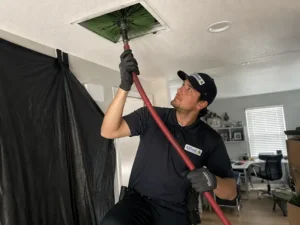
Clean ductwork behind a plugged filter goes right back to dirty. Couple months, maybe.
Most houses around Prescott have the one-inch fiberglass filter in the return, and when I ask how long it’s been in there I get a pause and then a guess. Those catch lint. That’s about the ceiling on them.
A four-inch pleated media cabinet in the MERV 11 range catches a lot more of what actually bothers an allergy prone person, and it loads slow enough you’re changing it twice a year instead of standing in the filter aisle every month wondering which number you’re supposed to buy.
Here’s where people get hurt, though. You can’t shove a high-MERV filter into an old one-inch slot and call that an upgrade. Choke the return and you’ll ice a coil or cook a blower motor. Somebody reads static pressure first.
When It’s Worth Having Someone Look
Musty smell off the vents once the monsoon’s been running that earns a look. Mouse evidence near a crawlspace run, same. Fuzz on the coil you can see with a flashlight, same. Kitchen tear-out that put drywall dust through the whole house, same.
Age by itself doesn’t. Registers look clean, equipment’s getting serviced, skip it a few more years and don’t lose sleep.
One thing worth knowing. The cleaning doesn’t need a permit. Replacing ductwork does that’s mechanical permit territory with the City of Prescott so pay attention if the conversation drifts from vacuuming to tearing out.
And an allergy prone household with leaky returns pulling attic air has a sealing problem, not a dirt problem. I’ve watched people pay twice before anybody thought to check.
Get Eyes On It First
If you don’t know which problem you’ve got, pay somebody to look before you pay anybody to clean. It’s good to have an ally when the guy in your driveway is the one telling you to hold off on the duct cleaning. Waiting just buys you another spring of guessing at it.
FAQ
How often am I supposed to do this?
There’s no schedule, whatever anybody tells you. Condition drives it. Most houses around here are fine at seven to ten years unless there’s been a remodel, a leak, or something living in the ducts. Get it looked at before you book it.
Will this help with the juniper?
Not much, honestly. That pollen’s coming in every time a door opens from late January into March. Cleaning takes out what already settled inside the system. Allergy prone at this elevation means managing the load, not ending it.
Worth it with two dogs?
Sometimes. Depends whether there’s dander actually packed at the returns. Grooming and a decent filter do more day to day than one cleaning ever will, so I’d fix the filter situation first and look at ducts later.
Can’t I just do it with my shop vac?
You’ll get the first two feet of every run. What matters sits deeper, in the trunk lines and the low spots. No negative pressure on the system means you’re mostly moving dust around instead of pulling it out.
How do I know if somebody’s ripping me off?
Ask what they’ll photograph, before and after, and whether returns are included or just supplies. Anybody leading with a mold scare before they’ve looked at anything isn’t who an allergy prone household wants in the house.
Pull a register cover off this week and look. Ten seconds and you’ll know if this is even your problem.
